Read a new original book: Air and Screen - Combined History of Aviation and the Media

Read a new original book: Air and Screen - Combined History of Aviation and the Media
Read ''Air and Screen'' in Amazon Kindle

Thursday, October 10, 2013

Gaston Bachelard and his book Air and Dreams

Main
Like any previous transportation revolution, from the wheel up to the steamer, Aviation gave its masters the tools for world conquest. But unlike land and sea which are the cradle of human activity, Air is a completely new field of activity. Humanity lacks the cultural background to connect the imaginary vision of flight, central for mental development, to practical aviation activity. The dialectic between flight and airplane is vague and destructive. Problematic relationship between aviation and flight were prominent in the case of Nazi efforts to become world rulers while accelerating aviation development with Racialism.

Content
Famous French philosopher Gaston Bachelard [1884-1962] specialized in the role of imagination. His concept of ‘Dynamic Imagination’ is valuable to anyone interested in developing creative abilities.

According to Bachelard, Imagination is created by any movement. Human will is to integrate with that movement. Thought is the search for way how to do it in practice. Philosopher who wishes to understand mankind must concentrate on learning the poets.

Bachelard described the benefits for the imagination as a result of being united with a one of the four material elements. These elements are good conductors of all that is real and provide continuity to the imaginative mind. World of phenomena present in this way primary examples of change and movement. ‘Poetic End’ is a precursor to the practical end needed by the organism.

In his book ‘Air and Dreams’, published in 1942, Bachelard describes the psychological concepts of flying experience.

Any element which the imagination practice is capable of producing special sublimation, purification and clarification. Aerial sublimation is of the purest type. It is carried on with a light dialectical clarification.

It looks as the flying creature moves beyond the actual atmosphere in which it is flying. There's always room to rise further and the Absolute is the final stage of the consciousness of freedom created in this way. The adjective linked most to the noun ‘Air’ is ‘Free’! Natural air is free air.

The aerial phenomena are the most obvious and regular. They give us guidelines to very important psychological feelings: standing up, growth, climbing, flying and purification. These feelings are the basic principles of Developmental Psychology that can be called ‘Flight Psychology’.

In the heart of every psychological phenomenon there is a real sense of verticality. This verticality is not empty rhetoric. It is a principle of order, scale over which a person can experience various degrees of emotions. Mental life, all delicate and subtle feelings, hopes and fears, moral forces involved in our future, have vertical differential, in the full geometrical meaning of the word. Especially notable are the images and thoughts associated with the fundamental values of the soul: freedom, joy, lightness, sublimation.

Elevation, depth, decline, fall, etc., are axiomatic metaphors par excellence. Nothing explain them and they explain everything. In simple language, if a person wishes to live them, feel them, and above all combine them with real life, he realizes their primary quality and naturalness. It is impossible to express moral values ​​without reference to the vertical axis. Every nerve in the body is a vertical transmitter. The imaginary air is a mental growth hormone for mankind.

If we want to really know how things evolve, the first thing to do is to determine the extent of which they make us heavier or lighter. The positive or negative vertical differential indicates well their impact and purpose for the mind.

First principle of the ‘Ascending Imagination’ is: of all metaphors, the vertical metaphors, such as light, height, elevation, depth, decline, fall, are consensus metaphors above all else. Nothing explain them and they explain everything. More simply, if a person wants to live, feel and above all compare them, he realizes that they have primary quality and are more natural than all others. They are the best expressions of almighty Gravity. Man has to learn to weight them in order to know their value for him.

Although this intangible aerial metaphors concerns us more than substantial metaphors, our language is not adapted to them specifically. Language is conditioned by forms and cannot easily make the picturesque images of dynamic height.

Nevertheless, these images have extraordinary power. They control the dialectic of enthusiasm and despair. Vertical boldness is so vital and clear. Its superiority can not be disputed. The mind can not turn away from it after recognizing its immediate and direct meaning. It is unable to express moral values ​​without regard to vertical axis. After studying the physics of poetry and physics of ethics we believe that any courage is vertical.

Individual images are the effective way to define vertical orientation. The focus on individual expressions allows us to experience a unique tonal quality of the aerial hopes, hopes that are not disappointing us because they are not heavy. These hopes are associated with words of hope, words of the inner immediate future which let us discover new ideas, exciting and fresh, original ideas that are our new treasure.

Aerial imagination imagery evaporate or freeze quickly. We therefore always capture them between constantly active two poles.

The words 'wing' and 'cloud' provide evidence for the bi-polar quality within a single aerial image. They may be a mirror or an illusion, a drawing or a dream. They carry the ambivalence of grim reality or soft imaginary. They are metaphors before being analyzed as nouns and adjectives. But only for a short moment we capture their exact meaning for us. We trust these poetic images which are too non-physical, but does it willingly.

Aerial imagery impact the entire entity. After we got very high and far we certainly find ourselves in a state of open imagination. Images of freedom present a problem if their various stages are not tested one by one. Same difficulty exist with truths delivered in open and liberating air. In the Infinite Air dimensions are deleted and we come into contact with non-dimension material that gives us a sense of total internal purification. We are in a state of repose and movement at the same time.

After we arrived by air so far and high the mind is carried away out of control as by drug. Eager to try the upper air reality, the imagination will double any impression by adding any new available image to it. In its new different form, the mind express a resemblance between ambiguous contradictory images, which blur the colors of good and evil and violate the most stable laws governing the values ​​of humanity. The end result of this yearning may be ambivalent moral significance.

There is, naturally, the journey down. Fall, even before moral metaphors intervene, is constant psychic reality. But the images of dynamic falling are few and poor, in contrast to the numerous images of ascension. Psychological downfall is simple, negative, short, scary, meaningless, isolated, nothing, emptiness. It has poetic and moral value only when it is connected to the positive dynamic verticality which is clear and rich in images and contribute to rising up.

Mental slope is constantly changing. If the slope increases, the person straighten up. Paths to greatness are created among us in this task. Everything in the mind is a path. Each path encourages us to soar.

Indeed things are growing. The way of energies, in imagination and reality, is to expand too much. Will is always a wish for power that does not exist at the present. Superman, who arrived by air so far and high, has no equal rivals. He is sentenced, without being able to go back, to existence full of pride in the legendary pantheon of heroes, even though he may never admit it, even to himself.


Folklore fits well with the images of flight. Great images hidden inside legends suddenly get wings, blooming with new meanings. Allegedly meaningless, they has psychological benefits after being analyzed.

The German tales became a catalyst in the development of German nationalism in the 19th century. German soul absorbed and implemented them as an ideology that attributes special qualities to this nation at the expense of ethics.

Airplanes at the beginning of the 20th century, the early era of aviation, were too appealing to be simply integrated into the hierarchy of human needs only.

In addition to the innovation of technological power tool, the airplane is very similar to a man spanning his arms and therefore it can be easily be personified. The plane is a ‘Medium Became Message’, like all the basic primordial aerial metaphors which Bachelard described.

Aerial Consciousness is a term meaning the use of the general public interest regarding aviation to the purpose of creating a complete world view.

In the first half of the twentieth century various thinkers and ideologies combined the airplane with the Ascent Psychology, in several countries seeking a modern definition, leading to the establishment of a Dictatorship of the Air.

Aerial Consciousness shaped the political stage and life of Nazi dictatorship.


Source:
Nazi Germany Aviation as Major Cause for the Holocaust
Poetic and Healing Research
Part A – Chapter 1
Author: Avinoam Amizan
Wednesday, October 02, 2013

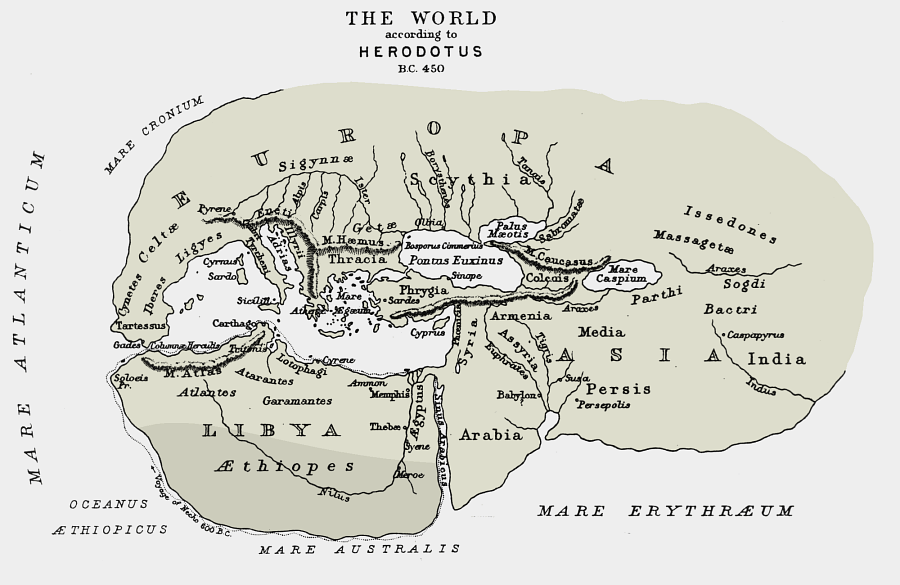
Map of the world according to Herodotus - 450 BC

Map of the world according to Herodotus - 450 BC

Herodotus the Greek cartographer drew the map of the known world in his time quite accurately, as far as of places that were then familiar to mankind.

Some prominent features on the map are:

Land of Israel is the center of the world, connecting three continents: Asia, Europe and Africa . This indicates its central importance even at that time.

Continental boundaries were not known and they are drawn in a circle .This design served as inspiration for the symbolic world map of the medieval time, of a circle divided with straight lines.

The overall shape of the map reminds human head, where the rear is in the east and the face is in the west:
- Land of Israel is the the jaws' axis
- Africa is the jaw
- Europe is the forehead and nose
- Asia is the back of the skull
- Mediterranean is the oral cavity 
- Black Sea is the nasal cavity

Rivers and seas are drawn with great sensitivity, drawings which remind of arterial blood and central nerves.

In view of this similarity , there is no doubt that the head shape was in his mind when Herodotus drew the map.

Thus we can learn from the map that in the classic past the landscape was used as a source of inspiration for the Study of the human body and vice versa.

Map of the Human Figure of Israel continues this line of thought of constantly striving to discover the world while constantly striving to search the human body.

Original maps in the Human Map of Israel website are a tangible expression of the philosophical outlook of micro and macro Cosmos, in which human beings inner world is a reflection of the outside world and vice versa.

Human Figure Map of the Holy Land adds another layer to the Bible, that have made the simple geometric center of the continents an interest point of fascinating stories.

Friday, September 27, 2013

Holocaust and Aviation - Hannah Reitsch - Look for the Woman

Use of the saying 'Look for the Woman' in study of historical biographies of leaders, especially dictators, indicate the roles played by their wives in the rise and fall of their countries.
The search for the woman behind the rise and fall of the Third Reich leads the researcher to one woman, who more than any other woman affected the fate of the Nazi regime. The woman is Hanna Reitsch, whose image and career as a test pilot inspired the regime and shaped and sealed the fate of Germany.

Hanna Reitsch [1912-1979], daughter of a Nazi doctor, began her career as an excellent glider pilot who broke more then 40 world records over a very long career of fifty years in various categories, before and after World War II. As a result she became a test pilot, before and during the war, of the most advanced and important fighter planes of the Luftwaffe.

Her autobiography, 'Flying is My Life’, is the source of this chapter in 'Holocaust and Aviation’. Her flights descriptions, fascinating and unique, are evidence of her skills as a pilot. Reitsch expands in describing her experiences of many unique flights and most of the book is devoted to her love of flight. But at the same time she emphasizes her blind loyalty to Hitler and the Nazi regime, which gave her the opportunity to fulfill this obsession. The racial anti-Semitism in Germany, which was an inseparable part of everyday life, is not addressed in the book in any way, and it is understood that for sure she supported it.

Reitsch gradually became one of the pillars of the regime, because propaganda of German aviation achievements was an integral part of the Nazi Aerial Dictatorship. As a woman she became one of the most prominent symbols of propaganda, and made many international tours for flying in air shows to foster foreign relations.

Hanna Reitsch had short and thin boyish figure, with pretty but common face and appearance. It is not clear if she was considered a personality who dictated style for women, but certainly she was important and far more famous than any other pilot in the world, including well remembered Amelia Earhart from her time. Earhart was global media star who dictated the international agenda during her daring flights. After Earhart disappeared in the Pacific in 1937, she left a void which helped Reitsch become the most famous woman in the world.

Despite her membership in a conservative right-wing party with oppressing views regarding women, she was in her behavior opinionated, unconventional, inspiring, and controversial. She was a human figure larger than life, full of striving for self-realization and breaking conventions. She is remembered in history as someone who, because of her obsession, drifted off the regular course of life and flew on the fast track toward her self destruction. That is only a superficial observation. Actually she was cold minded person who represents the entire Nazi regime human pattern of technicality and ideology. She was a desired woman who broke hearts of many men and it made her image look lighter.

Hanna Reitsch influenced the liberal world, the German public, and the fanatical Nazi leadership altogether. She was a famous hero with two 'Iron Cross' decorations. She held a stick with two ends. On one hand, she had international recognition as an ambassador for the masses of the aviation world, but on the other hand she was at the forefront of developing the secret weapons of the Nazi army. It was an unusual combination that was unmatched in Nazi Germany. It placed her in a position of great control and option to succeed Hitler along with her friend, Luftwaffe general Ritter Von Greim, who was Hermann Goering's successor at the end of the war.

More than any biographical fact it is significant that her own career reflected accurately the whole history of the Third Reich:
At the beginning, at the early 1930th, she studied in close relationships from some of the fathers of the gliding sport in Germany, a sport which was the link between military aviation of WWI aircraft industry and the Air Force set up by the Nazis. She became world famous after being the first woman who crossed the Alps in a glider. Later on she participated in numerous international air shows as a glider pilot, including one in the USA in1937, as Nazi propaganda messenger.
Later in her career, in the late 1930th, she became an outstanding test pilot for Ernst Udet, head of the development department of the Luftwaffe, during its quick arming and in the first phase of Second World War.
She introduced to the Luftwaffe the revolutionary diving brakes, which she and her friends invented in the 'German Institute for Gliding Research' which was her home base. Diving brakes became a standard part in all Nazi combat planes from the Spanish Civil War and to later on.
Another important development of her and her friends from the 'German Institute for Gliding Research' was the transport glider, out of the small sport gliders. Transport gliders, who could carry significant number of soldiers and military equipment, were vital for air transport in those days of relatively small airplanes. Transport gliders helped the Nazis win the swift offensives in France and Crete.
A third important contribution of her to the Nazis, as well as to the entire aviation world, was being the first successful helicopter pilot in the world. Not only that she could fly an operational helicopter successfully for the first time, but she also flew it in a closed arena in Berlin, in front of thousands people, every night for few weeks in 1938. Charles Lindbergh became her friend.
In retrospective, these three major aviation achievements could be sufficient reason for Hitler to declare a world war.
In the early 1940th, at the height of the war, she was involved in several ambitious aircrafts projects designed to destroy the Allies, of which most known is the rocket interceptor the 'Comet'. The Comet was a very fast and maneuverable glider with rocket engine which launched it to the center of bomber formations, where it could attack them for few minutes. The Nazis had great expectations from this wonder weapon but it failed. Reitsch suffered serious injuries after a crash in one of the last test flights in late 1942, an episode which became a defeat sign for Nazi Germany, few months before Stalingrad.
After recovering, towards the end of the war when Nazi Germany collapsed, she established a squadron of Nazi volunteers in order to use them as pilots of guided bombs. After convincing Hitler, who was isolated and detached in Berghof, about the need for this squadron, she cooperated with famed Commando colonel Otto Skorzeny to transform the V-1 guided missile to a pilot version. It too failed due to short sighted Nazi leaderships who failed to understand, in her words, 'the urgent need for large scale project of such kind'.
Hanna Reitsch was among the few pilots who made constant flights to destroyed Berlin during the last months of the war in early 1945, including the famous last flight to Hitler in the last days which was etched in the collective memory of the neo-Nazis.
Although remaining after the war a declared sympathetic of the Third Reich, her post war international gliding activity resulted in many new contacts. Her vast connections were then with old Nazi leaders, German rocket scientists and western political leaders altogether. She contributed greatly to rehabilitate Germany's international standing.

Because in many ways Reitsch was a role model of a woman larger than life, whose courageous pilot fortitude opened new avenues in aviation, her autobiography challenge the critical attitude towards Nazism. She remained a citizen, but her relationships with the highest hierarchy, including Himmler who was a personal friend, leave no doubt about her importance to the Nazi regime. The answer to the riddle of her character is in the complex social reasons for the rise of Nazism. She was a devoted family member. Her father, a doctor, wanted her to follow his steps and she became a medical student. The German doctors were notorious for their sympathy with the Nazi regime, which introduced modern medicine together with the race theory and deportation of Jewish doctors. Her youth dreams of being a flying doctor in primitive Africa were realized in the diabolical Nazi regime. Women in macho Nazi society were educated to join semi military spheres of duty in the hinterland and created similar cruel ethics. Like most citizens of Germany she contemplated about full identification with the regime. But prominent events that should be a warning sign for her, like Nuremberg Laws, violation of Versailles treaty, occupation of Czechoslovakia, Kristallnacht and the Final Solution, were ignored by her, probably as a 'necessary evil'. She leaved in a dictatorship where only partial information was available to the doubting citizens, but belonged to the generation which grew up with the Nazi regime, and their destinies were combined. Her love of flying was combined with German patriotism, admiration for Hitler the leader of the nation, and the many personal benefits derived from it. As a test pilot, a challenging and dangerous career, she was also trapped in a process of 'survival of the fittest' where only the few best and well connected survived. This too contributed to her obsessive solidarity with the regime she represented.

Hanna Reitsch wrote 'Flying is my life’ in chronological order describes around her important flights. She describes the technicalities, landscapes, feelings and friends. The total is very personal and difficult to separate into its components.
For this reason probably Reitsch did not won the right attention from scholars of the Nazi regime. In Holocaust and Aviation a separation was made between the components, and her whole career is repeatedly described from four major perspectives: ideology, society, aviation, politics. Chronological order is maintained to some extent: Hanna Reitsch was a young ideological woman, who as a glider pilot became famous record holder, recruited as a test pilot for the most advanced aircrafts, eventually to be influential personality in the Third Reich and later on. 


Source:
Nazi Germany Aviation as Major Cause for the Holocaust
Poetic and Healing Research
Part B – Chapter 19
Author: Avinoam Amizan