Read a new original book: Air and Screen - Combined History of Aviation and the Media

Read a new original book: Air and Screen - Combined History of Aviation and the Media
Read ''Air and Screen'' in Amazon Kindle

Tuesday, November 13, 2018

Maps Of The Human Mind


The human mind think in pictures and mental maps help us to visualise ideas, concepts and enhance memory and learning.  Like the maps our forefathers use to navigate the oceans and discovery new lands, mental maps help us to think out of the box.


The human brain learns and orientates itself by forming mental maps of familiar places and situations.  Similar to a physical map, these mental maps not only shows the perception of the maker, they form landscapes in their own rights.

“Looking at a map can teach us more with our eyes in an hour than we can learn from our ears in an entire day”.  This valuable insight was expressed in 1605 by the cartographer Thomas Fuller. By looking at a historical map, you will get an idea of how strongly a particular image of the world can determine people’s thoughts and actions.  For many thousands of years, most Europeans believe that the world was flat and therefore had no idea of the real position of the continents and the oceans in relation to one another. This conviction imposed considerable limitations on how far seafarers were willing to travel.   It obviously hindered any endeavours for discovery. This was because people believed that they would fall off the edge of the Earth if they traveled far enough. They had a limited idea of the vast expanse of the oceans and the lands beyond the horizon.

Before sea adventurers could venture into new lands and uncharted seas, a new picture of the earth had to be thought of.  Once this gained gradual acceptance, the speed with which exploration took place took off. Bit by bit, mile by nautical mile, the whole world gradually opened up to explorers and discoverers.  If the Genoese seafarer Christopher Columbus (1451 to 1506) had not had the audacity and vision to imagine that the earth might be round, and that new land might be discovered by sailing westwards,  sea exploration might have been held back by decades or centuries. Later generations of Europeans would have held on to the erroneous opinions that Asia was on the eastern part of the world and cold therefore only be reached by crossing the eastern oceans.

In our modern work life, we often use many expressions that show the significance  of visual pointers for human action. For example, when your company has embarked on a marketing plan, you might say that you can “see what is wrong with our marketing strategy and decide on the next course of action”.  Quite often, it is very difficult to organise an action without having a mental picture of the result you wish to achieve. For example, if you have a problem, the solution to that problem comes easier if you can visualise it.   Then you devise a map to find solution or routes to solve the problem or work around the problem. Similarly, mentalists who to achieve great feats of memory recall use mental maps to train their memory and improve their memory techniques.   Students have also been trained to use mental maps to improve memory, their study skills and accelerate their learning. They do this by breaking down course structure down to subjects, down to topics and down to detailed concepts or formulas, much like the a map of a city or town.

Basically, your mind think in pictures and having such mental paths help anyone from a busy executive, managers or marketing people to plan new campaign or product  strategies. The paths make it easy to link a seemingly unrelated concepts or ideas to a bold new strategy or package an old product into something new using fresh ideas.  With such mental maps, you use your ability to retrace paths in your mind and to store maps to your memory in a manner much more easier than you think.

So like the maritime  maps of old, new frontiers are being discovered by understanding the natural way the brain thinks, stores information and solves problems.  All made possible because mental maps frees the  limitation of conventional human thinking.


Source: Free Articles from ArticlesFactory.com


ABOUT THE AUTHOR


Martin Mak has developed a new program to help people enhance their memory and learning experience.  Find out how with his free and popular ecourse at
http://www.mightymemory.com/memoryarticle.html


Monday, November 12, 2018

Humanization in daily life and religion


Humanization is the giving of human qualities to inanimate objects, animals, forces of nature, and so on. In Greek the concept is called Anthropomorphism, a word that means 'human form'.

In the language of speech and writing, humanization is a kind of common metaphor, designed to create an emotional impression. Examples are: the bosom of the earth, the howl of the wind. It is one of the most characteristic traits of humankind.

In everyday life, thinking about important objects is common as having human qualities. Advances in artificial intelligence can make humanization an even more significant phenomenon. Artificial intelligence greatly increases the humanization threshold of computers. Advanced computers can display specific human behaviors, such as learning from error or expecting to receive certain information. Of course there are also robots that mimic the movements and shape of people. At the same time, many devices are already operating according to instructions in speech.

Humanization of animals has been accepted since the dawn of mankind. There are alternative books and teachings dealing with the comparison between human traits and animal traits. The theme is common in children's books. Examples include: Isofus Proverbs, Animal Farm, Alice in Wonderland, Winnie the Pooh, Wind in the Willows, and so on.

Walt Disney took the theme of comic anthropomorphism and brought it to the center of culture. A central part of the children's time is devoted to watching cartoons, in which animalism is very common. Characters from Mickey Mouse, Kermit the Frog, Bugs Bunny, etc., are for the children a significant imitation heroes.

The pantheon of gods in Greek mythology is entirely of humanized figures: Zeus, Hera, Apollo, Poseidon, Eros, Venus, Mars, and others. Mythology stories are mostly the story of the gods' plots among humans. Below the gods there is a level of demi-gods, which is the result of a pairing between the gods and ordinary human beings, who became human beings with divine attributes, such as Perseus, Hercules, and Psyche.

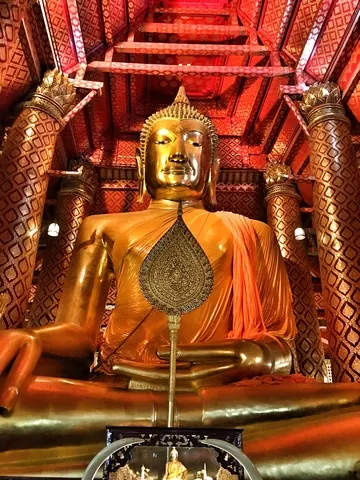
In the Hindu religion there are many deities, each of which has specific and distinct human characteristics.

The monotheistic religious faith generally considers it wrong to describe the God of Judaism, Christianity, and Islam as human. God is abstract in form and properties. However, it is very difficult for the average person to describe God without an anthropomorphic framework. It should also be noted that the biblical creation story describes God creating man in His image.

Modern geographers are aware that religion can be a starting point for building an ethnic and national identity, and religious ideology and practice have a great influence on location. Immigration processes have also created landscape changes, as there are many immigrant communities defined by religion.
Public places not defined by religion in the recent past, including the city, the neighborhood, the street, the schools, and many domestic spaces, and at the same time parts of the media and the economy, have become areas that combine religious practice in an informal manner. In this way, humanization has, in fact, became the most important driving force in interpersonal communication.


dreamstime_xs_63291596.jpg
Rocks in human figure forms are a powerful attraction


dreamstime_xs_76517833.jpg
The fox is one of the most beloved animals


Heroes of Walt Disney


Child and robot


Zeus, the head of the gods in Greek mythology 


image002.jpg
God creates man in his image and likeness 
in the fresco in the ceiling of the Sistine Chapel


dreamstime_xs_57332458.jpg
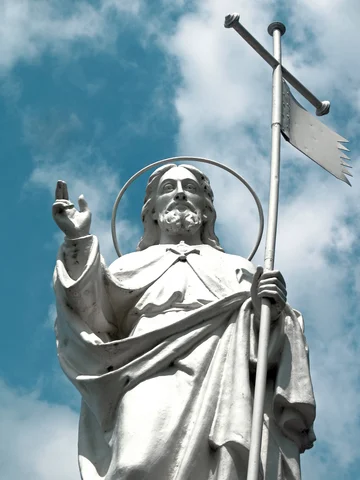
Jesus Christ - a person who has become a divinity


dreamstime_xs_86519391.jpg
Buddha - a human being who became a deity


dreamstime_xs_85295199.jpg
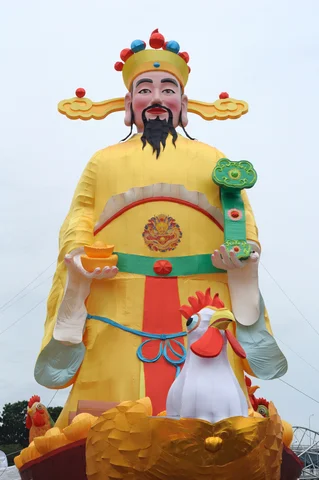
The god of fortune in Chinese culture


dreamstime_xs_46258246.jpg
Ganash - a Hindu god with an elephant head and a human body


Sunday, November 11, 2018

Imaginary anatomy and art


The basic actions through which a person's mind is reflected are through his care of his body: cleanliness, concern for health, eating, and the like. We think of the anatomical body as our internal reality. A means through which one can examine society, culture and the human condition. But our bodies are hidden from us. What happens under our skin is mysterious, frightening, fascinating. In the distant past, the inner structure of the human body was a matter of speculation, fantasy, and little research, and there were very few attempts to present it in pictures. The development of anatomical research, together with the invention of printing and the subsequent flow of printing technologies, helped to inspire new and striking anatomy. Imaginary anatomy flourished, full of information but also strange, surreal, beautiful and ridiculous - exposes the external world as much as it exposes the inner world.

At the beginning of the modern era the boundary between art and science was undefined yet. Anatomy experts and their artistic partners used familiar ways of portraying them through religious and artistic landscape symbols. The artists tried to create precise illustrations, but also surprising, beautiful and entertaining.

Between 1680 and 1800, anatomy experts began to explore the imaginary elements of the scientific illustration. The reliability of anatomy, they claimed, was impaired by visual delusions, imaginary landscapes, and comic poses. When the ancient printing technologies became sophisticated, a style of brilliant and dreamy hyper-authenticity emerged, which showed, with great artistic talent, more sophisticated knowledge and an updated perception of the interior of the body.

In the 1930s, Fritz Kahn in Germany produced a series of books on the inner workings of the human body. He used metaphors taken from the industrial world: production lines, internal combustion engines, refineries, power generators, telephones, and so on. The body in Kahn's works was 'modern' and productive, a subject emphasized visually through innovative art. Although his books sold well, his Jewishness, and his preaching for public reforms, made him the target of Nazi attacks. He fled to America in 1940.

The anatomical presentations in recent years offer us traces of our inner selves. The artist / scientist / journalist Alexander Ciaras is inspired by the worldview that the anatomical body is a microcosm, a 'small world', and what is found in the external world is also found within man and is revealed through the science of anatomy. Ciaras uses body scanners and laser holograms to create images of the human body that combine an accurate description with an artistic touch.

In everyday life, we are surrounded from all sides by spectacular visual representations of our body organs, from the entire body, through individual organs, to microscopic cells. These perceptions are embedded in every move we make. It seems that the eye is not satisfied with these illustrations, and the brain asks them for more and more, without ever finding the way to satisfy what he wants.

The systemic approach, which has taken a great deal of control over all areas of scientific thought today, has led to anatomical and biological systems in general being compared to artificial systems used by man, as well as information systems. The action of the human body is defined as the action of different systems, and the systems created by man in all spheres of existence try to learn from the manner in which these systems work and enact them.

One of the central themes in art is 'nature landscapes'. Artistic freedom allows the artist to create imaginary landscapes on the canvas, which, after hanging on the walls, become an inseparable part of the world picture of the occupants of the house.

Classical architecture places emphasis on the 'human front' of the buildings. This was achieved through design, decorations and sculptures. The combination of human figures and textures on the façades of luxury houses and squares contributes to the urban landscape.

While the anatomical description is committed to scientific precision in describing the human body, the art of painting enjoys great freedom in this field. The creation of plastic art that combines people with landscape descriptions unites them. Descriptions of the landscape become the reflection of man, and vice versa. Many of the great painting artists anthropomorphized the landscapes that were the background to the characters that were the theme, and one example is the Mona Lisa background.

Before the Renaissance there were no landscape paintings, at least not as we understand them. If anything, landscape was just a background view of the human figures. It was gradually changing. When the trees, the mountains, the fields, and the oceans began to stand out, a strange phenomenon occurred: the anthropomorphic landscape. Human forms in fact merged with the landscape, as if nature is nothing without the human narrative. It was as if one could not appreciate an art that did not returned in reflection, in the literal sense of the word.

These paintings usually included a hidden face in the landscape, as if to indicate that the earth was the one that shaped them, and its meaning is only the use made of it. This was especially true for some 17th century artists in the Netherlands. They produced a large number of works depicting the silhouette of a bearded man appearing in profile over rocky mountains. The beginning of the trend can be traced to the image created by the scholar Kirscher. He said that his design was inspired by a story about the plan in ancient times to sculpt a huge figure of Alexander the Great on Mount Athos.

Impressionist painters who were considered unacceptable at the end of the 19th century, but whose works are sold at record prices at the beginning of the 21st century, emphasized the general impression that the figure and the landscape combined, at the expense of the accuracy of the description. In this style, it is much easier to combine the subject with the landscape in the background and to prominently portray the human essence, both physical and spiritual.

The painter Salvador Dali described with his brush surrealistic visions in which the human body crumbles against a desert landscape, thereby creating an authentic combination of anatomy and geography. The painting is a political protest against the war. Dali was able to create a shocking picture, which leaves a great impression on the viewer, because of the frame created by the body organs against the sky, a composition that is a call to action for the subconscious.

Post-modern artists deconstructed the scenes they described for the basic elements. They created a way to describe the living and the inanimate with molecular tools. The postmodern architecture has abandoned the pure functional style, with its straight lines and flat, transparent facades, typical of skyscrapers in city centers. Architects like Frank Ghery have returned to human integration in the landscape of buildings they have planned, by creating structural disorder, which is actually a fitting facade of the physical sensation in the spatial environment of the building, and simultaneously gives a sense of its goals.

Artists today use digital technologies to create images in the style of fantastic realism and science fiction which is widespread in comics and cinema, with works such as Metropolis, Blade Runner, The Spirit in the Shell, Star Wars and others, whose plots take place in geographically imaginative places. At the same time, the body of the human characters in them is usually hybrid, part of it natural and part artificial. The theme of these works is always how much the human attributes can be stretched through anthropomorphism.


הציור 'מעשה טוביה'
"The Make of Tuvia" by Tuvia Katz [1652-1729] 
compares the body to the interior of the house


האנטומיה ההיפר הריאליסטית של גוברד בידלו [1640-1711]
Morbid hyper-anatomy of Gubard Beidlo [1640-1711]  


קאהן - מערכות העיכול והנשימה כמפעל כימי
Fritz Kahn - the body as an industrial palace


אלכסנדר ציארס - עובר
Alexander Cyaras - Fetus


Frontal illustration of the head that highlights the muscles


dreamstime_xs_60614666.jpg
Building facade decorated with sculptures in Bellini Square in Naples


Vinslast Haller - landscape as a human face, 17th century


דאלי – התראה על מלחמת אזרחים - 1936
Dali - Civil War Alert - 1936


dreamstime_xs_40748464.jpg
Frank Gehry - Buildings leaning like a group of men, Dusseldorf


The Spirit in the Shell - A Science Fiction Movie, 2017


Saturday, November 10, 2018

Metaphysical Geometry and the Golden Ratio


All the ancient cultures patiently arranged a correspondence between the heavens - especially the sun's orbit and the zodiac, with the settled land - and especially with the holy buildings and important cities, and with people - especially the religious and governmental elite.

Various researchers present enormous astrological diagrams in the Mediterranean basin. The zodiac stretched across the land and the sea, and passed through many centers of pilgrimage in ancient times. The architects of these huge earthly zodiac signs turned their country into a living image of the sky.

Other sacred geographies have a whole base that comes from geodesy, the branch of mathematics and applied geometry, which deals with measurements and distances on Earth, and the location of points on the surface. These special measurements evolved into geometric paintings over vast expanses of triangles, squares, and circles, and more complicated geometric forms and connections. Ancient builders erected temples in the landscape, which were placed exactly according to the knowledge of sacred geometry.

The ancient Egyptians ruled this science. The main line of ancient Egypt was determined to cross the country in half. Cities and ceremonial centers were deliberately built at distances measured precisely from this sacred longitude. Even in ancient Greece, religious centers were all separated from each other by precise distances.

We find evidence of ancient landscape geometries in France, Germany and England. Researchers have found extensive evidence in these countries for a linear arrangement of ancient sacred sites over long distances. Their source is a huge system of merchant routes that were built in the Neolithic period. Archaeological findings have since confirmed the Neolithic origin, but the idea that the lines were used for transport purposes should be ruled out. The lines form a straight arrow on the ground, making them impractical for useful transportation. These are energy lines, and in fact there is a sense of energy or power flowing along them, felt by people with sensitivities to earth energies.

This category belongs also to straight lines created on the landscape by archaic cultures in the Western Hemisphere. Examples include the Nasca lines in Peru, similar lines across Bolivia's deserts, and many linear signs left by Indians in the Chaco Canyon area of New Mexico. These lines are also integrated into giant drawing of animals and humans in adjacent geometric shapes. These are spiritual lines - a symbol created on Earth to represent the spiritual journeys, magical flights and experiences outside the body of ancient shamans.

The Nasca lines in Peru are the most important example of huge shaped lines on the landscape. The lines were discovered in the 1920s when regular commercial flights began over the desert. The lines can be identified as meaningful shapes on when viewed from the air.

The Nasca Desert is a high, arid plateau that stretches 85 kilometers off the coast of the Pacific Ocean some 400 kilometers south of Lima, the capital of Peru. The creators of the lines belonged to the Nasca culture, which existed between 200 BC and 600 AD. The lines form hundreds of shapes, whose complexity varies from simple and straight lines of up to 20 kilometers, to triangles and trapezes, to complex and stylish forms of animals such as birds, spiders, monkeys, lizards, whales, and even human figures. The lines were formed by digging the dark gravel that covered the desert and removing it to the side, so the lighter surface was revealed. The color of the lines is yellow and beige, and their depth is no more than a few centimeters. The total area of the lines is nearly 500 square kilometers and the length of the greatest characters reaches 270 meters. The lines are preserved due to the stable weather, which is windless and very arid.
The conventional archaeological theory is that the Nasca people created the lines with meticulous planning and simple technologies, and in a relatively short period of time. The lines are the remains of 'walking temples', in which a large group of believers walked along a predetermined pattern, which was dedicated to a unique sacred entity, similar to the custom of walking through a maze. They asked the gods to ensure that the water will continue to flow to them from the Andes through the extensive underground water channels they have constructed.

In Christian and Islamic Europe, in the Middle Ages and the Renaissance, painters were known to define the initial design of their paintings according to different geometrical formulas, imitating and perfecting ancient knowledge. According to this approach, the placement of elements within the painting is as important as the theme itself. This geometry was integrated into the worldview, and in the planning and construction of temples, public buildings, and entire cities.

Particularly prominent in metaphysical geometry formulas is the 'Golden Ratio'. This is ostensibly a simple mathematical series of numbers, but it is also referred to as the 'divine proportion'.

The golden ratio is the series of numbers in which each bigger number is the sum of the two numbers before it:
Let's take the number 1 and add it to 1. To the result 2 we shall add the previous number 1 and the result is 3. To 3 we shall add the previous number 2 and the result is 5.
Here are the first numbers in the series:
1,1,2,3,5,8,13,21,34,55,89,144,233,377,610,987,1597,2584

In this series of numbers there are many interesting mathematical phenomena. The most important is that the ratio between two consecutive numbers in a series, for example between 5 and 8 or between 21 and 34, is always about ... 1: 1.618. 
This ratio is never an integer. 

The 'Golden Section' is the name of the geometric form of the arithmetic golden ratio. The basic geometric form is that of a line divided into two according to the golden ratio: the length of the smaller part of each line relative to the larger part is like the length of the largest part relative to the entire length of the line.

When you take two consecutive lines in this sequence and form a rectangle, you get a rectangle of elegant dimensions known as the Golden Rectangle. 
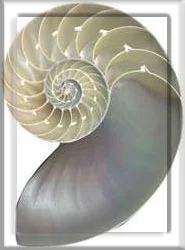
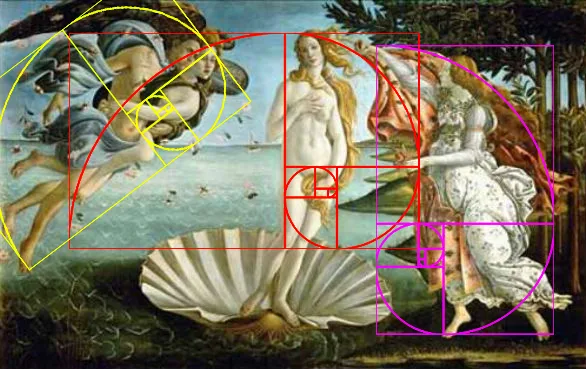
This rectangle can be divided into sub-squares, smaller and smaller. If you draw an arch between two opposite edges in each inner square and connect all the arches created, you get a spectacular shape, called the Golden Spiral.

The golden section was discovered through practical experience thousands of years ago, and was used by the ancient architect, who debated what is the best point in dividing one line into two parts. The most beautiful dividing point is when the two parts of the line have the golden ratio between them.

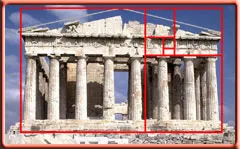
The dimensions of the Great Pyramid in Egypt, the Parthenon in Athens and the Pantheon in Rome were designed according to the golden section. The ratio was the central visual concept and the focus of religious attraction in these temples. The ratio appears in various places in the buildings, from the general appearance to the rooms. The golden ratio is considered, since then, the most perfect form in art. The great Renaissance artists made sure to use it. It is found in Mozart's symphonies. It is also common in modern art and is used by architects, musicians, poets and designers.

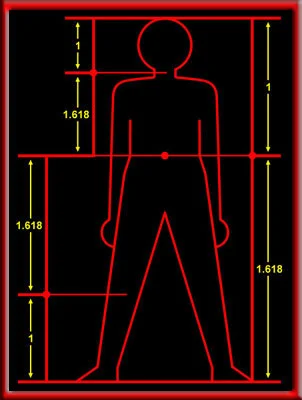
The golden ratio and the golden section are also of great importance in the natural sciences because they appear in innumerable and very different natural phenomena. The organs of the human body are shaped according to the golden ratio. This fact was one of the principles of classical sculpture in the ancient world. The relationships in the human body produce the deepest effects on the human mind. The DNA form is also of two integrated gold spirals.

It is therefore possible to say that the reality in which we live is built to a large extent according to the principles of this ratio. The golden ratio has been used by builders of temples already in antiquity, whereas modern scientists have found that it is one of the basic mathematical frameworks of the universe. Its effects help shape a harmonious personal world, because it is used in nature, science, and art. This is the perfect standard. Preoccupation with it created entire worldviews, in past and present. Historians attribute great importance to the golden ratio in shaping human history and knowledge.


A 100-meter-long bird drawn across the Nasca plain in Peru


golden section


The golden ratio in a graph of rising and falling


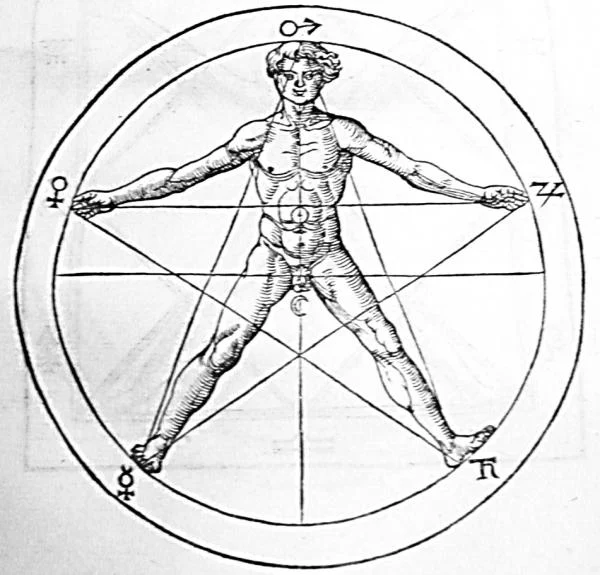
The golden ratio in a pentagram, the most known star shape


The golden ratio in the Great Pyramid of Egypt


The golden ratio in the Parthenon of Athens


Human dimensions according to the pentagram


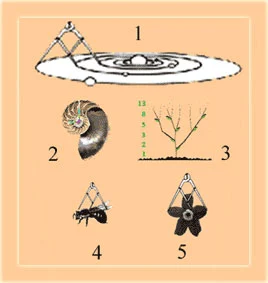
The golden ratio in nature


golden ratio in the human body


The golden ratio in the fingers


A golden rectangle and the golden spiral inside


A golden spiral shaped conch


The golden ratio in the DNA


The UN building is a golden rectangle


A golden rectangle in Renaissance painting


golden spiral in Botticelli's Venus painting


golden wave.jpg
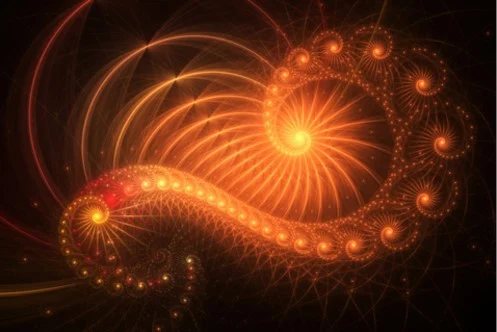
The golden ratio as an infinite wave